
Bill McSpadden: An Interview with Jackson Gingrich
Bill McSpadden is known for undertaking a variety of projects that benefited the Town of Slaughter Beach. The ones that may have the longest-lasting impacts for children and adults alike were those that encouraged us to engage with nature in very enjoyable and meaningful ways. They also furthered environmental benefits that our town enjoys today.
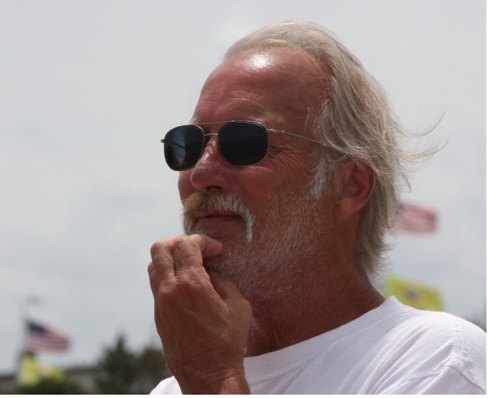
Four projects that Bill worked on produced the most notable impacts on our town environment: (1) The Delaware Bay horseshoe crab sanctuary; (2) Leading our town to be a national Certified Wildlife Habitat by the National Wildlife Federation; (3) Leading or co-leading projects that provided educational opportunities for children; and (4) coordination of annual spring beach grass planting for dune protection. These projects may seem straightforward and uncomplicated to do, but, in fact, they required long-term, committed efforts that had to be coordinated with many agencies and organizations to reach fruition. Bill worked closely with ERDG (Ecological Research & Development Group led by Glen Gauvry), DNREC (Delaware Department of Natural Resources and Environmental Control), and the Slaughter Beach Town Council that sought approvals to end live horseshoe crab harvesting from the beach and preventing them from collection, dead or alive, for fertilizer production. The project demonstrated that the town protected horseshoe crabs, and other wildlife, in multiple ways. Importantly, volunteers began conducting annual town horseshoe crab censuses and getting the public to “just flip ’em” instead of picking them up by the tail, which severely damages their critical tail muscles. Horseshoe crabs’ tails are essential in righting themselves when flipped on their backs along a beach. After several years of promoting and implementing these programs, ERDG declared that Slaughter Beach had achieved official horseshoe crab sanctuary status in 2004.
Bill’s second major nature-promoting project proved more complex. The goal was to have our town become a Certified Wildlife Refuge by the National Wildlife Federation. This challenge required specific coordination efforts with various relevant organizations in order to attain certification. Those organizations included the Delaware Nature Society, led by Brian Winslow; DNREC Division of Watershed Stewardship, with significant help from Anthony Gonzon and others from the Division of Fish and Wildlife; DelDOT (Delaware Department of Transportation), for street improvements to Bay Avenue; the National Wildlife Federation, the Slaughter Beach Town Council; and 20-30 residents’ properties that agreed to committing to specific actions for wildlife support. There were detailed requirements for each signed-up resident’s property, and the Town as a whole. They included providing food, water, shelter, resting and nesting areas, as well as undeveloped spaces for wildlife and parking for visitors. At the behest of Bill and Harry Ward, a town leader and multi-term Mayor, DNREC’s Division of Watershed Stewardship produced signage stations displaying wildlife photos and explanatory labelling at each Town cross street as well as at the Town Pavilion adjoining the firehouse. The Division of Fish and Wildlife (FWS) and Prime Hook National Wildlife Refuge, which has several miles of border with the Town, provided letters of support. The time and effort needed to reach the end goal took several years, and Bill, our Town, and individual participating citizens were recognized by the National Wildlife Federation as Certified Wildlife Habitats. Our Town was just the third town in the state to accomplish this goal in 2015.
Bill’s third major undertaking was to guide the project to install a 345 foot, Y-shaped elevated walkway. Instead of wooden pallets just sitting in the marsh, the walkway would enable school students, town citizens, and other visitors, a path to walk above the marsh so they could see and experience wetland marshes, wetland plants, and many creatures that lived there. The concept and design phase was financed through the DNREC Bayshore Initiative, contributions from the Delaware Nature Society, and the Dogfish Head Brewery. The construction phase of the boardwalk and viewing area with all its pilon supports, viewing areas, benches, and telescopes, would end up costing approximately $400,000 and several years’ effort to be finalized. DelDOT financed most of the construction funds through a DelDOT Transportation Alternative Grant.
It is noteworthy that about 10 Slaughter Beach residents, including Bill and Harry Ward, had installed the 30-foot pole and osprey nest several years earlier. It was placed and raised 100-feet plus into the marsh from the expected end points where the boardwalk viewing spots were projected to be. Ospreys actually began nesting from the day the initial pole and nest box was installed, so public viewing of ospreys occurred long before the boardwalk was completed.
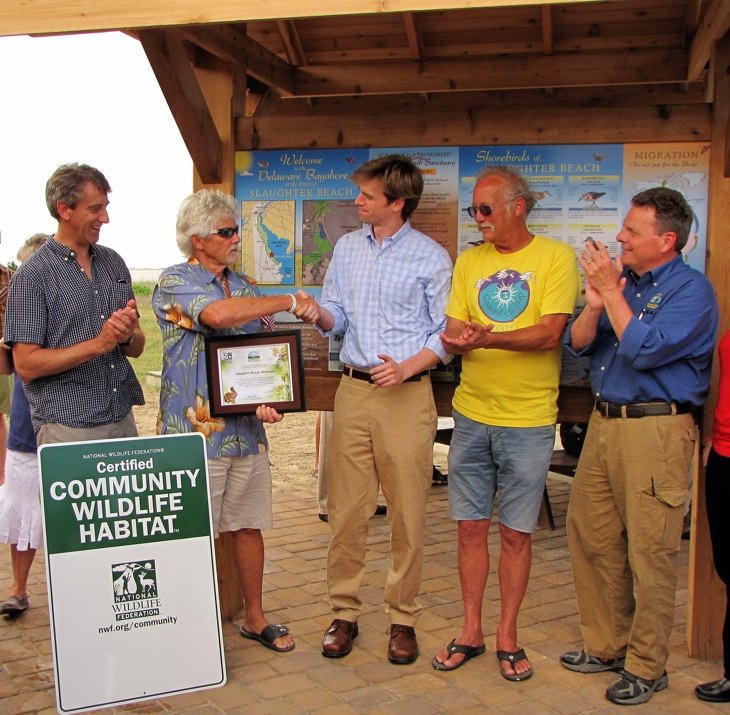
Overall, the wildlife viewing, boardwalk, and saltmarsh access project ran from 2016 to its completion in 2019. The boardwalk was officially opened on April 12, 2019. Below is a photo of officials at the ceremony. The photo shows Bill McSpadden being recognized by state and local officials for his work in developing Slaughter Beach to be recognized as Community Wildlife Habitat.
Lastly, Bill’s commitment to naturalist goals was his coordination of public beach grass planting with DNREC-supplied American beach grass. This effort entailed acquiring and coordinating appropriate planting of beach grass every March. Although dune grass planting was largely performed by townspeople and volunteers, coordinating dune planting in areas which had lost the most grass or sand required good judgment by Bill and other citizens. Such coordination assured that new grass was planted on dune areas that were most damaged during winter storms. Bill’s efforts continued at least 10-12 years before the Town itself began coordinating the task sometime about 2015-16. All in all, nature could not have had a more tenacious leader than Bill when it came to preservation of our town’s exquisite natural beauty.
Grace “Bubbles” Pierce-Beck, Noted Environmentalist
By Diane McFaul Hindman
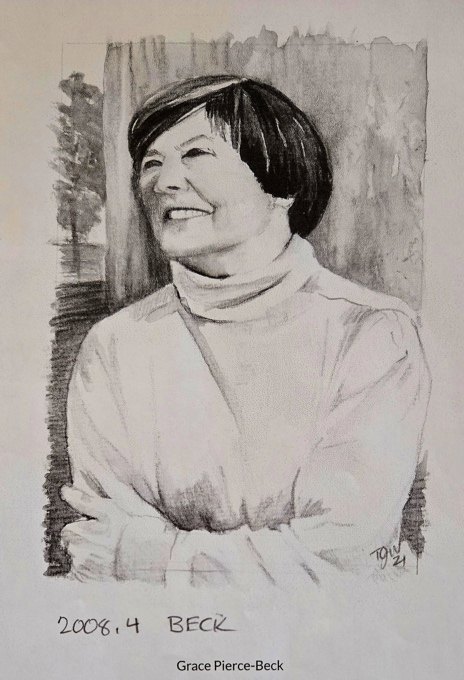
Grace Pierce-Beck (1926-2008) was one of Delaware’s most influential environmentalists, a petite, soft spoken woman, also known as “Bubbles” by her friends; who battled against polluters and in support of our fragile shoreline and to protect our horseshoe crabs.
In her early years, she lived around New Castle County and she spent many summers on the Chesapeake Bay where she learned about fishing and native plants from her father. After World War II, she lived in Dover and spent summers in Slaughter Beach, at 435 Bay Ave, adding to her love of nature having “spent my life between 2 Bays”. It was through local politics that Pierce-Beck met former Delaware Gov. Russell W. Peterson. She worked with Peterson to win passage of Delaware’s landmark Coastal Zone Act in 1971. She learned through Peterson “that you could reconcile conservative Republicanism with environmentalism.” She then went on to Washington to work as a lobbyist for the Wilderness Society.
Her husband’s illness prompted her to leave her Washington job and go back to Delaware. Over time, she took on key environmental issues along with being credited with inspiring the 20-year court battle between the Natural Resources Defense Council and the Delaware Audubon Society against the former Texaco oil refinery at Delaware City. In Delaware, circa the late 1990s, the case produced the largest settlement from a citizen’s suit.
As a long-time Delaware resident, Grace was one of the first to recognize the importance of horseshoe crabs. She was instrumental in passing regulations to save horseshoe crabs in Delaware. As a town councilwoman in Slaughter Beach in the early 1980s, Pierce-Beck urged local officials to remove only the dead crabs from the beach and let the live ones return to Delaware Bay. Representative V. George Carey, R-Milford, said initially he didn’t understand why Pierce-Beck was so passionate about the crabs. But later he came to understand her concern and worked with her to protect the animals. He described her as “the queen of horseshoe crabs.”
She received local and national recognition for her efforts and in 2008 was named to the Delaware Commission for the Women’s Hall of Fame. State environmental Secretary John A. Hughes said Pierce-Beck had a knack for finding a solution rather than fighting a point. “We owe her our lasting gratitude,” Hughes said. “Her fingerprints are all over many of the important things of modern-day environmentalism.”
“She was probably one of the most forceful, gentle souls that I ever met,” said Christophe A.G. Tulou, a former Delaware environmental secretary, “the policy, the process. She knew Delaware.”
Compiled by Diane McFaul Hindman, with credit to articles by Molly Murray, the News Journal, Delaware State News, and the Delaware Women’s Hall of Fame 2008.
References: