
There are several residents from Cedar Creek Hundred with ties to the Slaughter Beach area that served in the Revolutionary War. Brian Hunt’s website, forgottenpatriots.org, has researched and documented muster rolls, pensioner records, and other resources to document notable residents of Cedar Creek Hundred and how they contributed to the effort of the Revolutionary War. The Slaughter Beach Historical Society has documented a few of the contributors to the war effort from our area.
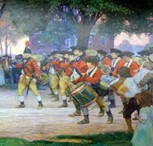
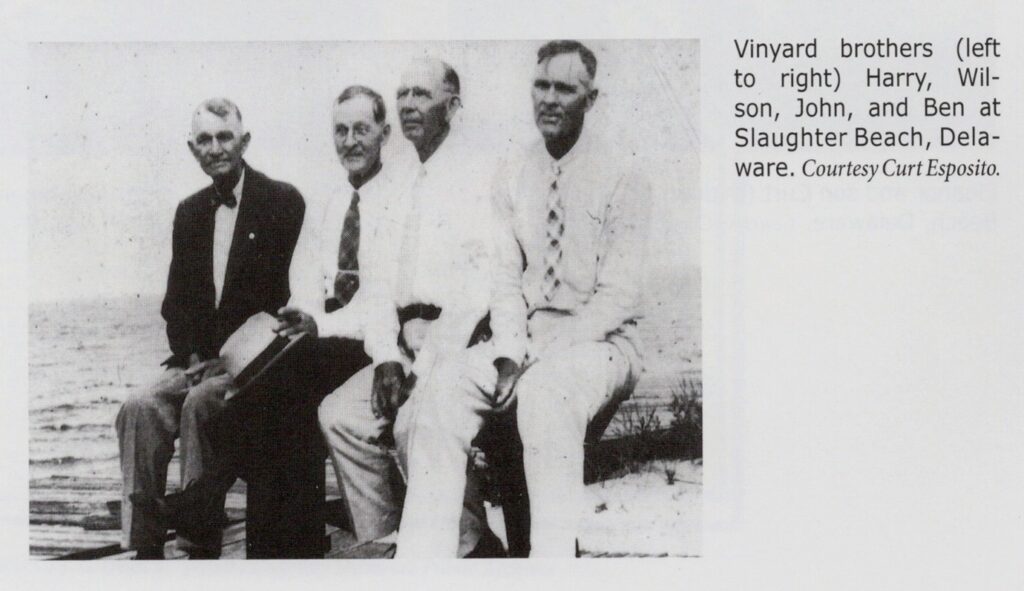
John Vinyard (1760 -1818) was from a long-time Milford family. He was a fifer/drummer in the 1st Delaware Regiment, The Blue Hens. The Delaware archives reflect his military service fighting in the Long Island campaign and later at White Plains when Washington retreated north from New York City. After the war was over, the Delaware regiment was sent south to fight in the Carolinas, John sold his position to Ferguson Jenkins, a mulatto, who then appeared on the rolls as John Vinyard. John Vinyard married and had one child, Curtis Vinyard Sr. (1787-1878) who served in the war of 1812 in Lewes, and married Sarah Austin, who died about 1870. They had seven children. Curtis Vinyard Sr’s son William Vinyard married Eliza Marvel, daughter Sarah Vinyard married George McColley, and son Curtis Vinyard Jr. married Mary Marvel Thistlewood. Notice the previous bold type names, because we are seeing some familiar name connections to the Slaughter Beach area. Milford residents were spending time at Slaughter Beach in the late 1880s, including the Vinyard family. Curtis Vinyard Jr’s son, Wilson Marvel Vinyard, was born and raised in Milford and was the owner of Causey Mansion and the Vinyard Shipyard in the 1930s. The Slaughter Beach connection came in the early 1920s when he purchased Lot #10 (now 331 Bay Ave) from Thomas Simpson for $400. Wilson Marvel Vinyard’s daughter, Eleanor Vinyard, met and married Vincent J. Esposito through their West Point connections. Their son, Curtis Vinyard Esposito, continued the 100-year family history of living in Slaughter Beach. A picture of the Vinyard brothers is at left. Pictured below is Curt Esposito in front of the original family cottage built in 1930 and located at the corner of Delaware Avenue South. The Vinyard and Esposito families have contributed a great deal of family and local history over the years, including a book on the historic Vinyard Shipbuilding Company, by Joan Lofland. The Esposito family provided Diane McFaul Hindman with a family history for the “Meet Your Neighbors”article published on sbhistory.org.

Colonel John Haslet (1727-1777)
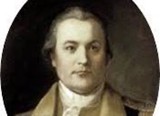
A native of Ulster, Ireland, John Haslet was born circa 1727 and emigrated to America about 1757. He came to the colonies as a widowed Presbyterian ordained minister but later became known for his medical skills and was sometimes referred to as Dr. Haslet. About 1764, Haslet married a widow, Jemima Molleston Brinckle, and had four children: Ann, Jemima, John, and Joseph. After playing an active role in the Pennsylvania militia during the French and Indian War, Haslet settled in the Milford area on a tract of land comprising 408 acres along what is now Airport Road. In January 1776, Haslet was commissioned as a colonel and given command of the recently formed Delaware Regiment. At the time, Delaware was known as the Lower Three Counties of Pennsylvania, not as a separate colony. He joined General Washington’s army in the summer of 1776, and the regiment fought bravely in the Battles of Long Island and White Plains. (Note: John Vinyard also fought in the Battles of Long Island and White Plains.) Haslet and the regiment remained with Washington’s taking part in the now-famous crossing of the Delaware River on Christmas night to attack the enemy at Trenton on December 26, 1776. Eight days later, on January 2, 1777, Haslet was killed in action during the Battle of Princeton. His wife died of grief within a year and leaving 5 small children orphans. (Haslet’s daughter by his first wife had joined him in the colonies after he became established.) His son, Joseph Haslet (1769-1823), and his siblings were placed in the care of Chancellor William Killan, who provided for their care and education. When Joseph became of age in 1804, he moved to Cedar Creek Village with his wife, Mary Draper. Cedar Creek Village was a small settlement around a gristmill built by Alexander Draper before 1727. The area is on Route 30 and what is now called Swiggett’s Pond. Joseph Haslet entered politics at an early age and ran for governor first in 1804 against Nathaniel Mitchell and lost, ran a second time in 1807 against George Truitt and lost, and was ultimately elected governor in 1810, defeating Daniel Rodney. He was Delaware’s 19th Governor, and served from January 15, 1811, to January 18,1814. Delawareans then elected him to a second non-consecutive term as their 24th Governor, serving from January 21, 1823 to June 20, 1823, when he died. He was the first Governor of Delaware to be elected to two non-consecutive terms of office.
Sarah Young Davis (1745-1822) Revolutionary War Patriot
Sarah Young was born May 1, 1745, the daughter of Robert Young and Christian Peterkin Young of Cedar Creek Hundred. Her story is unusual in part because we know quite a bit about her, unlike many other women of this era. According to Delaware militia records, Sarah made overalls and other uniform items for the First Delaware Regiment and was reimbursed £1 18s 6p in October 1781. Militia records also noted that her two brothers, Nathanial Young, Esq. (1741-1804) and Robert Young, Jr. (1760-1787), were reimbursed for militia expenses. Sarah married Mark Davis, the son of Nehemiah Davis, on September 5, 1765. It was also noted that her father-in-law, Nehemiah Davis, supplied 6 yards of dressed cloth for the Delaware Militia. Four members of the Young-Davis families are documented as patriots from Cedar Creek Hundred supporting the Revolutionary War. Sarah and Mark had 10 children, and most of them remained in Cedar Creek Hundred. Mark Davis died June 28, 1799, and was buried in the Nehemiah Davis Cemetery near Draper and Thirteen Curves Road. Sarah was recorded in the 1800 census as the “head of household” which was an unusual position for a woman at that time. Sarah passed away May 1, 1822, without remarrying. She and 3 of her sons joined Mark and were also buried in the Nehemiah Davis Cemetery.
Young-Davis descendants are still plentiful in the area, and for many years there was a family reunion of the Descendants of Nehemiah Davis. Starting in 1937, the reunion was an annual event held up until 1962.
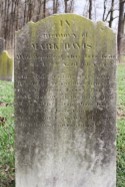
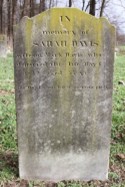
Nehemiah Davis Family Cemetery
Top: Headstone of Mark Davis, Sr. (1733-1799)
Bottom: Sarah Young Davis (1745-1822) Mark and Sarah are fifth great-grandparents of Linda Bennett White.
Credit and Acknowledgements:
• Local history articles written by Dave Kenton and used by the Slaughter Beach Historical Society with his permission
• Dssar.org, Delaware Society of the Sons of the American Revolution
• forgottenpatriots.org, website dedicated in part to Delaware during the Revolution
• Ancestry.com
• Delaware Archives
• allthingsliberty.com
• Family records from Linda Bennett White