
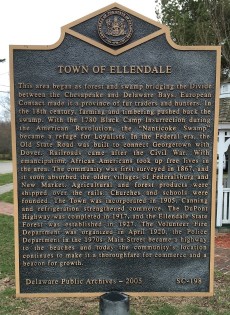
The Black Camp Rebellion began July 15, 1780 during the Revolutionary War. The American colonies were bitterly divided, and the colony of Delaware was no different. There was a group of Sussex County farmers who didn’t particularly care about who ruled them, but they minded the disruption of selling their goods to market, primarily in Philadelphia. Many of the farmers were destitute and resented the high taxes placed upon them. Initially, they met up to vent their frustrations, but as their discussions continued a plan was hatched to secure Sussex County for the British. Bartholomew Baynum was a prominent leader in the insurrection, mobilizing other farmers from the Cedar Creek Hundred, located near Slaughter Beach. The Cedar Creek group joined forces with a group from Broadkill Hundred, led by William Dutton, and together plotted to support the British, who they thought would win the war. The British had captured Charleston in May 1980, so the group of loyalists determined to enlist other locals and train them into militia. Their main camp was at Black Camp (near Georgetown) and in early August their campaign became public. In response to their uprising, the Delaware government sent General John Dagworthy, and a contingent from Kent County to capture the loyalists. The actual insurrection lasted three days, ending with the capture of over 200 loyalists. At an ad hoc tribunal, fines were levied against the loyalists, and 37 were sentenced to death, but since no one was killed in the rebellion, they were released. Subsequently, the Loyalists were treated poorly by the revolutionists, in hopes they would move away. The rebellion is noted in Delaware Public Archives for Ellendale, SC-198, shown below.
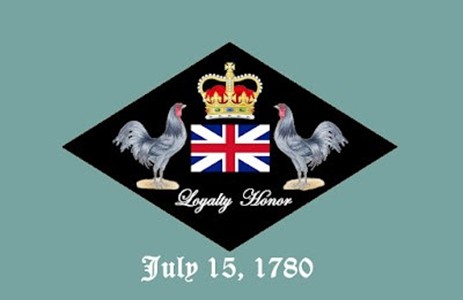
Fast forward to 2020, when Brexit became legal in England, a post-historic flag was created to commemorate the brief rebellion. The flag hearkened back to the Black Camp Rebellion with a nod to the Black Camp Loyalists, and the date of July 15, 1780. It included a black diamond, two Blue Hens, and a design similar to the Delaware colony flag. However, this flag created in England was not a flag used by the Loyalists in their rebellion but was a tribute to the Loyalists who favored the Crown. This flag was created as a teaching tool to underscore a real event in history.
Compiled by Joanne Plescia
Sources:
Zebratigerfish.blogpost.com. Saturday, February 1, 2020
1780 Black Camp Flag – Post Historical
The Voice of Vexillology, Flags & Heraldry
Wikipedia- 1780 Black Camp Rebellion
Delaware Public Archives: Marker SC-198