
by Linda Bennett White
Located at the corner of Argos Corner Road and Church Road, the Slaughter Neck Methodist Church has a long history in the area. The seeds of the church formed in 1777 when a Methodist Society was formed at Cedar Creek Village in the home of William Shockley by a traveling Presbyterian minister. John Copper was the first Methodist to preach in the area and was followed by others who were spreading Methodism in Sussex County. It was noted that Francis Asbury preached in Slaughter Neck July 13, 1776, and February 15, 1780, so there was not a regular minister assigned to the church until much later. On July 26, 1810, a meeting was held, and trustees were elected to guide the development of a new permanent church structure under the name of “Zion Trustees”. On October 7,1810, the trustees purchased 77 square perches of land from William Hickman and erected a “frame structure twenty-five feet square with a galley on three sides”1. This church was used until 1855, when an acre of land near the old site was purchased from Lemuel Draper and a new frame church was built in 1856 under the name of Slaughter Neck Zion Meeting House. When Mr. Draper died in 1877 it was discovered that he had not given the church a deed for the property so his widow, Hester O. Draper, corrected the error by presenting the church with a deed on May 1, 1880. In 1888, that church was rebuilt at a cost of $1600 with more improvements made in 1918. Early trustees of the church included many familiar surnames from the early settlers such as Mark Draper, Henry Draper, Lot W. Davis, Joseph A. Calhoun, Riley Wilson, John W. Bennett, John Argo, and William J. Hickman. The final Slaughter Neck Church was built in 1929 with masonry blocks, and finally replacing the 1855 wood frame structure.
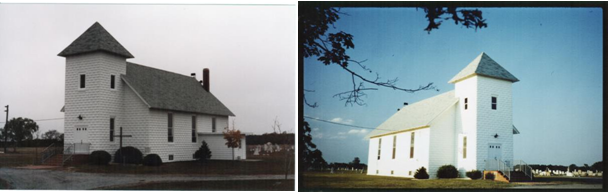
Photo circa 1950 Photo circa 1965
1 History of Delaware 1609-1888, J. Thomas Scharf, L.J. Richards & Co. 1888
The land for the present church was purchased from John P. Argo in a deed dated November 13, 1930. The corner stone was laid, and church was dedicated on November 24, 1929 by Reverend Joseph E. Holland, a native of Slaughter Neck. The first sermon was given by Reverend Otis P. Jefferson, also a native.
Slaughter Neck Church Cemetery
The cemetery was established in the land surrounding the church and was enlarged several times with purchases and donations from surrounding farmland. It is believed that the original meeting house stood to the left of the rear of the present cemetery. An additional ½ acre was purchased from Amos G. Bennett in 1911, and about 1/5 acre was donated by David A. Argo in 1926. Also, in 1926, Thomas Farens and his wife conveyed an area of about .225 acres which made the total acreage of the church and cemetery about 2.5 acres. No further acquisitions were made until 1947 when about 1/3 acre was conveyed from Hammond and Jeanette Bennett, making the total about 2.73 acres. The headstones contain many of the surnames from the original settlers and the church founders, such as Argo(e), Bennett, Campbell, Carey, Davis Draper, Dodd, Farens, Hickman Holland, Ingram, Jefferson, Messick, Prettyman, Roach, Shepard, Walls, Warren, and Watson, just to name a few. Before the church was established the residents often had family graveyards on their properties and some still exist today. The oldest grave here is that of Mary W. Hickman who died September 9, 1828.
In May,1986, the quiet little church and cemetery attracted national attention when an anti-abortion group chose to transport an aborted fetus from California to Delaware to attract attention to their cause of preventing abortions. Pastor Norman Stone led the group on a walking tour from Los Angeles, California, to Slaughter Beach and the Delaware Bay. He said he chose the location because he thought the name was significant. Pastor Stone’s actions and anti-abortion rallies received very mixed responses.
According to the pastor, Reverend Hubert Jicha and Doris Argo, secretary of the church, Pastor Stone was not totally honest about his intentions and did not get proper permissions from them to make the burial. After the burial, Pastor Stone and his group walked the 5 miles to the Delaware Bay at Slaughter Beach to symbolize a baptism.

The Slaughter Neck Methodist Church Today
The Church was used in more recent times as a meeting location for church and local functions as well as various groups, such as Boy Scouts and 4-H. In 2002, a fellowship hall was added to the original 1929 building, enlarging the building significantly.

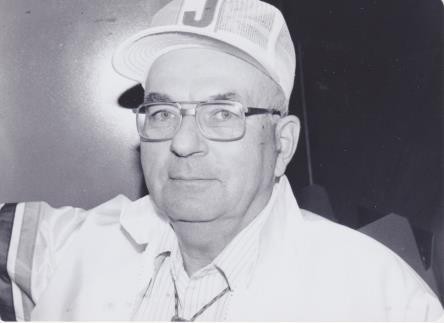
The graves of several well-known locals are in the Slaughter Neck Church Cemetery. A number of Bennetts are interred there, including Elmer Crerar Bennett, Jr. He was on the Church board of trustees for several years, the owner of a dairy equipment distributor, and a member of the Milford School Board from 1955 through 1959. He was also one of the founders of the Delaware Agricultural Museum in Dover.

Vinal George Carey was a longtime member of the Delaware House of Representatives representing district 36 from 1984 to 2010. He was also a farmer in the Slaughter Neck area.
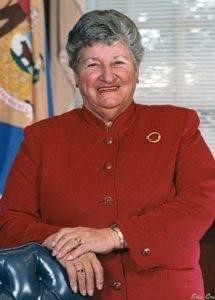
Governor Ruth Ann Minner was governor for 2 terms, from 2001-2009. She was a lifelong resident of Slaughter Neck and when she passed away November 4, 2021, her funeral was attended by Joe Biden. Her grave is in the same area as Baby Choice.