
By Linda Bennett White
Davis Landing is a small, 1.33 acre plot on Cedar Creek. It was originally part of Alexander Draper’s “Little Bolton” farm, which was acquired from a patent in 1677 by Governor Andros, in the name of the Duke of York, and consisted of 996 acres. This landing site for boats was used by 4 generations of the Draper family and was used as a wharf site as early as 1677. It stayed in the family until the death of Alexander S. Draper, when an Orphans Court petition divided his residual estate between his widow, Sarah; daughter Lydia S. Draper; and her three siblings. James B. Draper, William C. Draper, and Abigail. Lydia married Joseph B. Shepard and moved into the old Draper homeplace along the west side of the lane, Davis Landing Road. Lydia and Joseph Shepard negotiated to purchase the remainder of the Draper lands from the surviving heirs. At the intestate death of Joseph B. Shepard in 1896 all of his lands were purchased by his son, Alexander D. Shepard and his mother, Lydia S. Shepard, but were soon sold to William R. Alred, John B. Prettyman, John C. Davidson, and George H. Draper, Sr.. In 1897, George H. Draper and his business partner, David Reis, purchased Davis Landing and the farm surrounding it. George
H. Draper purchased the interest of David Reis in 1903 and established a cannery at the site. The cannery was operated by Captain William Murphy from the 1912 until a storm destroyed 2/3 of the 30,000 cases, exact date unknown, but before 1925. The cannery was abandoned, and the land was purchased by Charles E. Reed on December 5, 1925. The parcel is owned by the heirs of Charles E. Reed and is used as family recreational purposes today.
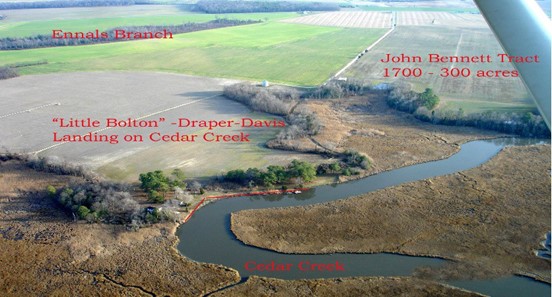
Photo courtesy of Dave Kenton
Early deeds describe the tombstone of Lainor (or Elnora) Sykes, with the inscription of “Here Lies the Body of Lainor Sykes, who departed this Life Ye 14 day of November, 1711 Aged 14 years”. The stone was within the 1.33 acre parcel designated as “Draper-Davis Landing”. She was likely an indentured servant in the household of Alexander Draper, Jr. The grave was located in the field to the east of the road leading to Davis Landing and has been referenced as a marker in every deed to the property. The original stone may still exist but as of this date it has not been located.
1897 Orphans Court Map

This is the Orphans Court map of Davis Landing made for the estate of John Shepard , and is noted “Lydia Shepard , 130 acres, 1897” including Davis Landing. Map copy courtesy of David N. Rutt, custodian of the old Sussex County Orphans Court records.
Murphy’s Cannery
Captain William Murphy was a well-known steamboat captain of several steamers that operated on the Mispillion River and Cedar Creek. In August 1907, he operated the steamer Greensborough and later was made the first captain of the steamer City of Milford in 1908. Captain Murphy was involved with several other Milford steamboats beginning around 1900, including the Emma Reis, named for the wife of Davis Reis, one of the owners of Davis Landing. In 1912, Captain Murphy invested in his own cannery at Davis Landing. He packed tomatoes, pears, peaches, and lima beans until sometime in 1924, when a storm destroyed 2/3 of the canned goods. His label was “Catherine’s Choice” and below is a copy of the only known label to exist.

Captain Murphy employed a number of local women to peel tomatoes and they were paid between 5 and 7 cents per bucket. Notably, among the “skinners” was Charles E. Reed’s daughter, Blanche Reed (Bennett) and his niece, Elena Reed Dodd (Dunn).
Murphy’s Cannery had a number of “firsts” for the canning business and helped launch a number of other businesses:
- First successful canner of lima beans
- One of the first to introduce out-of-season fruits and vegetables to Delaware.
- John Burris, of Milford, was the first trucker for the cannery, and launched Burris Logistics, still in business today.
- One of first canneries to have dynamo-powered machinery & electric lights.
- One of the first canneries to truck goods over state lines. Captain Murphy died of carbon monoxide poisoning in 1935. His son,
Herbert, wrote a detailed history of the cannery in 1978 at the request of the owner at the time, E. Crerar Bennett. That history is on the next page.

The following article published in the Milford Chronicle in 1912 shows the only known photograph of the cannery at it’s inception and explains the advantages the new cannery will bring to the region.

Davis Landing Today

Sussex County PDF Map dated 2003

Dock replaced circa 1960. Original “landing” ramp.

Remnants of the cannery: Foundation for dynamo-powered generator. Original warehouse floor.